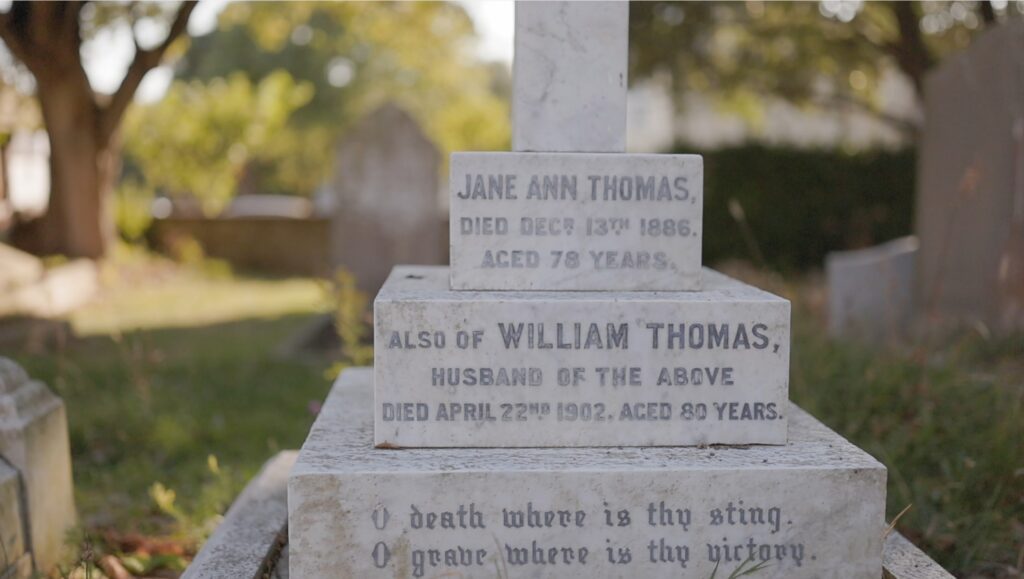
William 'Trunky' Thomas
Find out about this interesting character who lived in Rottingdean during the 1800s.
Meet Trunky Thomas. You’ve probably walked straight past him — his headstone’s in St Margaret’s churchyard. A farmer. A bathing machine proprietor. And perhaps something else?
He’s the first in a new short series from Rottingdean Heritage — dusting off some of the village’s characters and telling the stories that make up our village. There’s more in our churchyard than meets the eye.
Above: a short video about Trunky Thomas.
Read the Story
Here Lies… With Mike Laslett — Trunky Thomas, the Last Smuggler
In April 1902, this village buried a man called William Thomas. He was 80 years old and had lived here all his life. The census tells us he was a farmer and a bathing machine proprietor — very respectable. But the census doesn’t tell us he was a smuggler.
Everyone round here knew Trunky, and everyone round here had a nickname: Stumpy Mockford, Brasser Copper, Butty Bowles, Swipey Avis, Spotty Avery. Colourful names, to be sure, but useful too — because when the Revenue man came asking questions, Trunky is a very hard man to find when no one will tell you his real name. Nicknames here described a man’s appearance or his character. History doesn’t record which one Trunky was. Have a look at the photograph and draw your own conclusions.
And here we find ourselves at Trunky’s house. Believe it or not, it used to be called The Customs House. Trunky was probably the last of Rottingdean’s traditional smugglers, and he ended his days living in the very building the Revenue Service had used to hunt men like him. Built around 1780, and barely changed today. When the Napoleonic Wars ended, thousands of sailors came home and joined the Revenue Service, and they were so effective that smuggling collapsed and The Customs House was no longer needed. It became an ordinary home.
Trunky never owned it. It belonged to his daughter-in-law, whose husband, Frederick, ran the Royal Oak. She lived at the inn. The house stood empty, and Trunky, as ever, saw an opportunity. Trunky never was one for paying duty on anything.
And this pretty coach house behind me — well, that was Trunky’s cowshed. He kept a smallholding at Hutson’s, right where the western part of Kipling Gardens is today. From contraband to cows: a good smuggler’s retirement plan.
Today, this is the village butcher’s shop, but it used to be the first stop on any swimming trip: Nelson Stenning, the baker’s. And here you could have yourself thirteen buns for a shilling. Truly, the baker’s dozen — and quite possibly the only honest bargain in this entire story.
And this was where Trunky Thomas had his pride and joy: four wooden bathing machines. You climbed in, the machine was rolled down to the water, and you stepped straight out into the sea, modesty intact. Getting back up the beach was the exciting bit. A donkey turned a capstan wheel, hauling the machines jerkily up the shingle. And overseeing proceedings, Trunky Thomas, who would sometimes wring out the girls’ serge bathing costumes like ropes and hang them out to dry — all the while supervised by the young girls’ nannies, naturally.
His assistant was Stumpy Mockford — one leg, and yet the man who once swam out and rescued a drowning woman when her own husband couldn’t. The reward? Half a crown. The going rate, apparently, for a wife. And the lad leading the horse at the capstan? Doodle Wickenden, who years later wrote a poem recalling all the old nicknames of the village.
This village has a way of echoing down the years. In 1995, this shop caught the eye of three young comedians. Steve Pemberton, Reece Shearsmith and Mark Gatiss were in Brighton, performing at the Komedia. With a free afternoon and not much cash, they wandered out to Rottingdean to find a wishing stone, and ducked into the gift shop here at The Homestead — browsing the souvenirs under the burning gaze of the shopkeeper, Mrs Briggs, as they handled her special things. They insist Tubbs, the shopkeeper who murders anyone who isn’t local, was not based on Mrs Briggs. But that visit, they say, inspired the Local Shop for Local People.
A village of smugglers, nicknames and secrets becoming a local shop for local people — The League of Gentlemen didn’t invent that idea. Rottingdean got there a century earlier.
Trunky Thomas rests here beside his wife, a few hundred yards from the beach he worked and the coastline he knew better than any Revenue man ever could.
So many lives, so many stories — all here in Rottingdean by the sea. See you at the next one.
Below: Photo of grave of William and Jane Ann Thomas at St Margaret’s Church, Rottingdean